
How Many Solar Panels for a 1.5-Ton AC Do You Need in Pakistan?
Choosing solar panels for a 1.5-ton AC starts with its actual electrical input. You have one AC to run. Before you buy five panels—or accept a complete solar package—check what that AC actually needs from the socket.
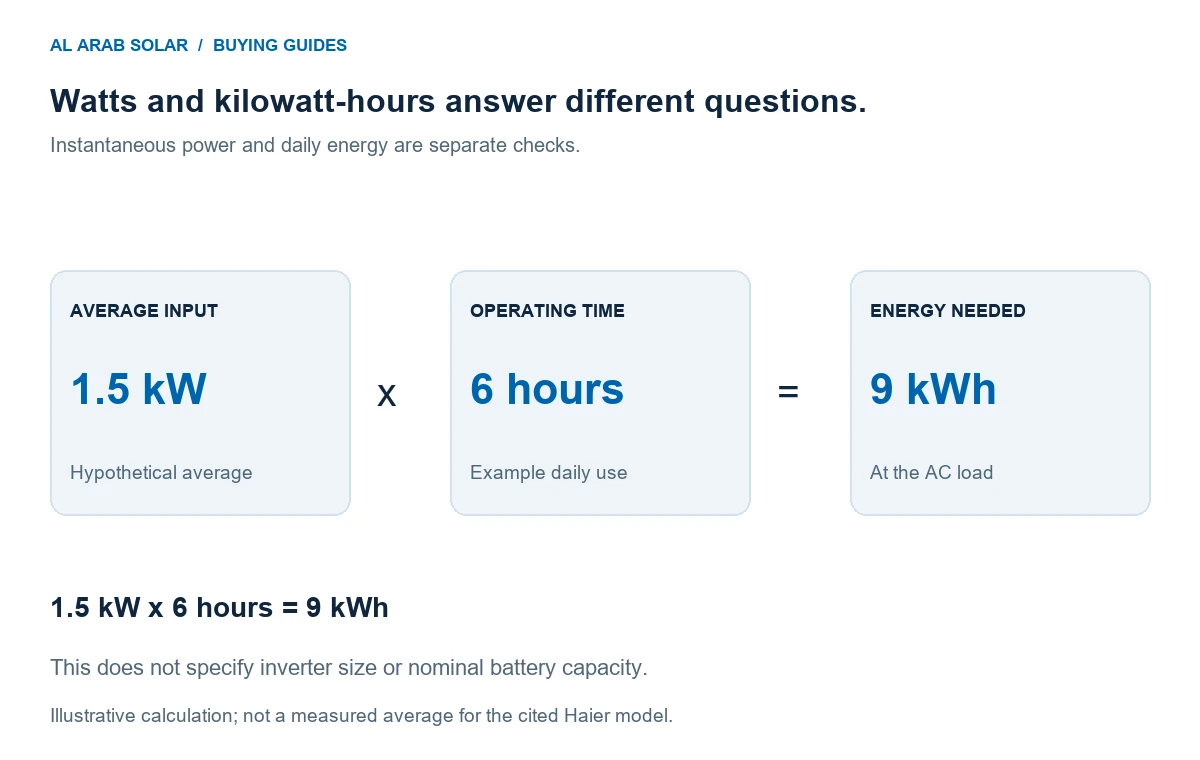
How many solar panels for a 1.5-ton AC do you need? There is no reliable count from tonnage alone. In the illustrative calculations below, a 1,500W running load needs four 585W panels under an assumed 75% available-output condition. A 2,210W load needs six at the same assumption. Daily operating hours, other appliances, battery recharge and inverter string limits can increase the final quantity.
These are planning examples, not a promise of uninterrupted AC operation. The output assumption is not a measured Karachi yield or an all-day minimum.
If someone asks how many solar plates are required for a 1.5-ton AC, the calculation is the same. Start with electrical watts, then check daily energy and equipment limits.
Table of Contents
First check the AC label: cooling capacity is not power consumption
The 1.5-ton label describes cooling capacity. It does not tell you the electrical input, how long the compressor runs or how much energy the room needs over six hours.
A useful real example is Haier HSU-19LF-PRIME/023DC(W). Haier Pakistan lists it as a 1.5-ton DC inverter model with a cooling power-input range of 0.52–2.21kW. That range is 520–2,210W; it is not a fixed daily average. Check the supplied model and its label against the manufacturer’s exact specifications.
This is why sizing everything around the lowest advertised amperage is a poor starting point. A cooled room and a hot room do not impose the same demand. Use suitable measurements to estimate daily energy, while checking the AC’s documented electrical limits for equipment selection.
Two different inverters: an inverter AC adjusts its compressor operation. A solar inverter manages conversion and supply in the solar system. Having the first does not establish that the second supports batteryless operation or your particular AC.
Solar panels for a 1.5-ton AC: 585W, 645W and 665W examples
For an initial power check on solar panels for a 1.5-ton AC, divide the simultaneous electrical load by the assumed usable power per panel, then round up.
Example: 1,500 ÷ (585 × 0.75) = 3.42 → round up to 4 panels.
Here, 75% is a deliberately stated illustrative operating assumption. It combines the reduction between array nameplate capacity and power available to the load at an assumed sunny operating point. Actual output can be substantially lower in cloud, shade, early morning or late afternoon.
| Simultaneous AC load | 585W panels | 645W panels | 665W panels |
|---|---|---|---|
| 1,200W — illustrative | 3 panels / 1.755kWp | 3 / 1.935kWp | 3 / 1.995kWp |
| 1,500W — illustrative | 4 / 2.340kWp | 4 / 2.580kWp | 4 / 2.660kWp |
| 2,210W — upper end of the cited Haier input range | 6 / 3.510kWp | 5 / 3.225kWp | 5 / 3.325kWp |
All counts use the same 75% assumption and exclude other loads. kWp is rated DC array capacity, not guaranteed AC output. These wattages are comparison inputs, not certified product combinations or stock promises.
Would four panels be enough? Four 585W panels total 2,340W on their labels. At the illustrative factor, they supply about 1,755W to the load. That covers the 1,500W example at that operating point, but does not cover 2,210W—and it says nothing about six-hour energy demand.
If a quotation says “four panels run any 1.5-ton AC,” ask which AC input, which operating conditions and what happens when solar output falls.
How much daily energy must solar panels for a 1.5-ton AC supply?
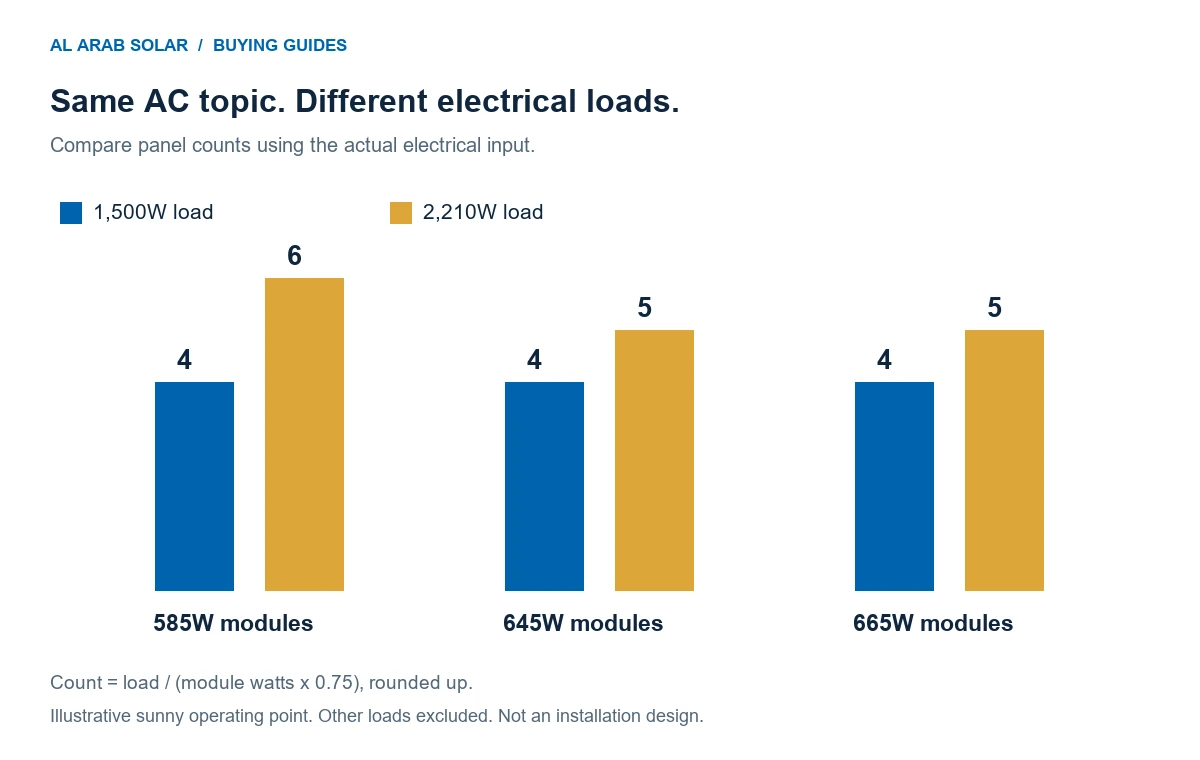
Power is a momentary requirement. Energy adds time. A load averaging 1.5kW over six hours uses 9kWh. That is a hypothetical daily average, not a measured result for the Haier model.
Array kWp = daily energy ÷ (effective sun hours × daily energy factor)
For the next table, assume 4.5 equivalent peak-sun hours and a 0.75 overall daily energy factor. These are editable planning assumptions, not a weather forecast or a verified seasonal resource value for your roof. One 585W panel then represents 0.585 × 4.5 × 0.75 = 1.974kWh/day in this simplified model.
| Illustrative usage | AC energy/day | Energy-based array target | Rounded 585W count |
|---|---|---|---|
| 1.0kW average × 4 hours | 4kWh | 1.185kWp | 3 |
| 1.5kW average × 6 hours | 9kWh | 2.667kWp | 5 |
| 1.8kW average × 8 hours | 14.4kWh | 4.267kWp | 8 |
When sizing solar panels for a 1.5-ton AC, do not choose the smaller number when the power and energy checks disagree. In the six-hour example, the energy calculation gives five 585W panels. If equipment planning must also cover 2,210W at the assumed available-output factor, that check gives six. An installer must then assess the actual load profile, supply arrangement and valid string layout.
The simple daily calculation cannot show whether generation and AC demand coincide hour by hour. A favourable daily total can still leave a shortage in the evening.
For a site-specific estimate, the PVWatts calculator models location, orientation and system characteristics. Its loss documentation separates its default 14% system-loss input from inverter conversion efficiency and temperature effects. Our illustrative 75% factor is not that default; do not add the same losses twice.
Include the fans, fridge and other loads before choosing the system
“For one AC” often turns into “one AC, two fans, the fridge and lights.” Put those appliances in the calculation now. Check both their simultaneous watts and their daily energy; they do not all run for identical hours.
Use our solar load calculator to enter appliance quantities, editable watts and hours, or use its manual-load option. It also provides battery and recharge planning inputs. Replace default appliance watts with your own equipment values. The result remains an initial estimate, not a verified string design.
Can solar panels for a 1.5-ton AC work at night or during an outage?
Daytime with grid support
With solar panels for a 1.5-ton AC, generation can offset consumption while sunlight is available. Whether the grid can supply a shortfall depends on the inverter’s supported operating mode and installation. A daily energy balance does not mean the AC runs entirely on solar at every moment.
Without a battery
Some systems support operation without a battery; others need one for the intended mode. Confirm the exact solar inverter manual and what happens during a grid outage. A normal grid-connected inverter must not be assumed to provide backup during load shedding. Do not connect an ordinary AC directly to solar panels.
After sunset or during an outage
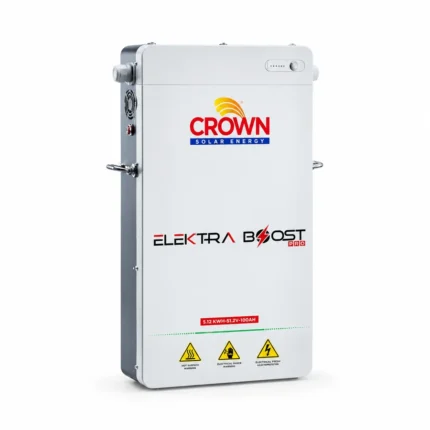
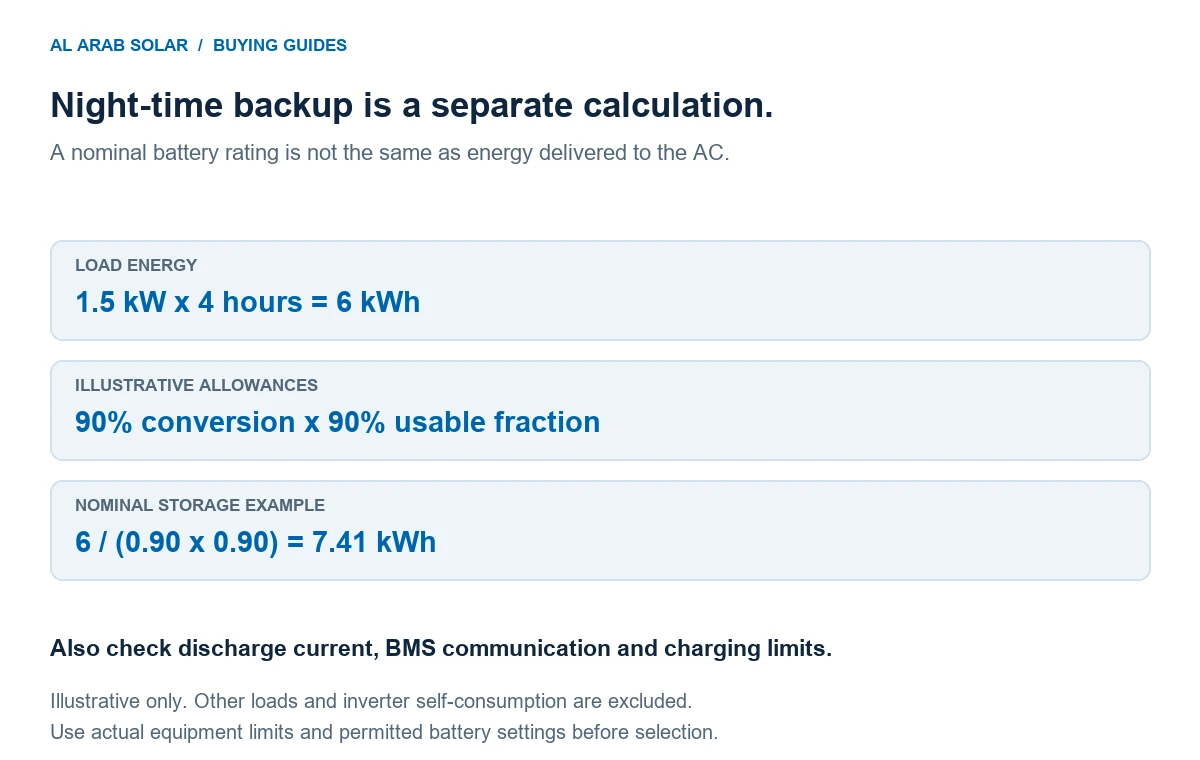
Panels do not store daytime energy. If you need AC backup without another supply, battery sizing is a separate task. As a calculation example, a steady 1.5kW for four hours needs 6kWh at the load. Assuming 90% battery-to-load efficiency and a 90% usable battery fraction gives 6 ÷ (0.90 × 0.90) = 7.41kWh nominal.
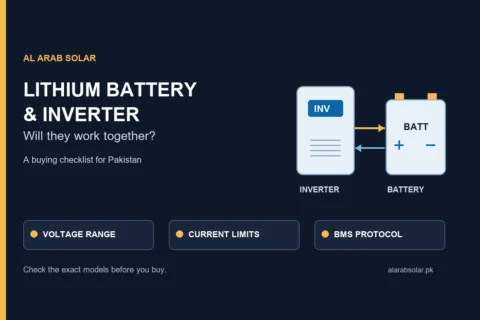
Those percentages are assumptions; use the actual battery’s permitted settings, condition and inverter losses. Include inverter self-consumption and other backup loads separately. Check discharge current, BMS communication and charging limits through our inverter–lithium battery compatibility checklist. A battery with enough kWh can still fail the power or compatibility check.
Energy taken from the battery must also be replenished. Add recharge losses and the daytime household load to the solar plan; do not size the panels for the AC alone and assume charging is free.
Before buying solar panels for a 1.5-ton AC: check inverter limits and roof fit
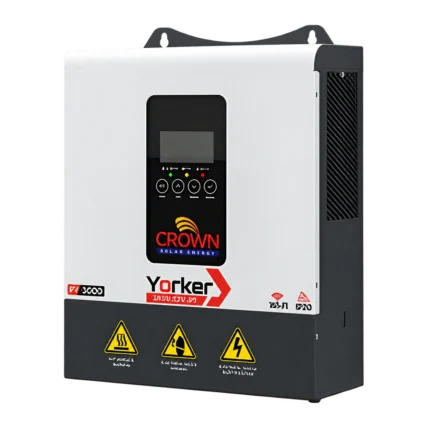
- Solar inverter output: check continuous output, temperature derating and documented starting-load support for the intended circuit. Do not assume one surge allowance fits every AC.
- PV voltage: the proposed string must meet startup and MPPT operating requirements without exceeding maximum permitted voltage under the design conditions.
- PV current: compare the supplied panel’s operating and short-circuit current with the inverter’s per-input limits. More panel watts do not automatically make a compatible array.
- Roof fit: confirm exact module dimensions, shade, access, mounting and usable space. A physically larger panel may reduce count without giving the best layout.
- Supply and protection: a qualified installer should specify wiring, isolation, earthing and protection. This guide does not provide a DIY wiring design.
Read our solar inverter buying guide for equipment selection, and the solar panel selection guide for comparing technologies and supplied models.
What about a 1-ton AC—or a non-inverter 1.5-ton unit?
Use the same two calculations with the actual unit’s electrical input and usage. Do not multiply the 1.5-ton panel count by two-thirds and treat the answer as a design. Different models, efficiency, room heat load and compressor behaviour can change the result.
Before ordering solar panels for a 1.5-ton AC with a fixed-speed compressor, verify running input and starting requirements from the manufacturer or suitable measurements. Avoid universal statements such as “every non-inverter AC needs one extra panel.”
Buying solar panels for a 1.5-ton AC? Compare the quotation assumptions
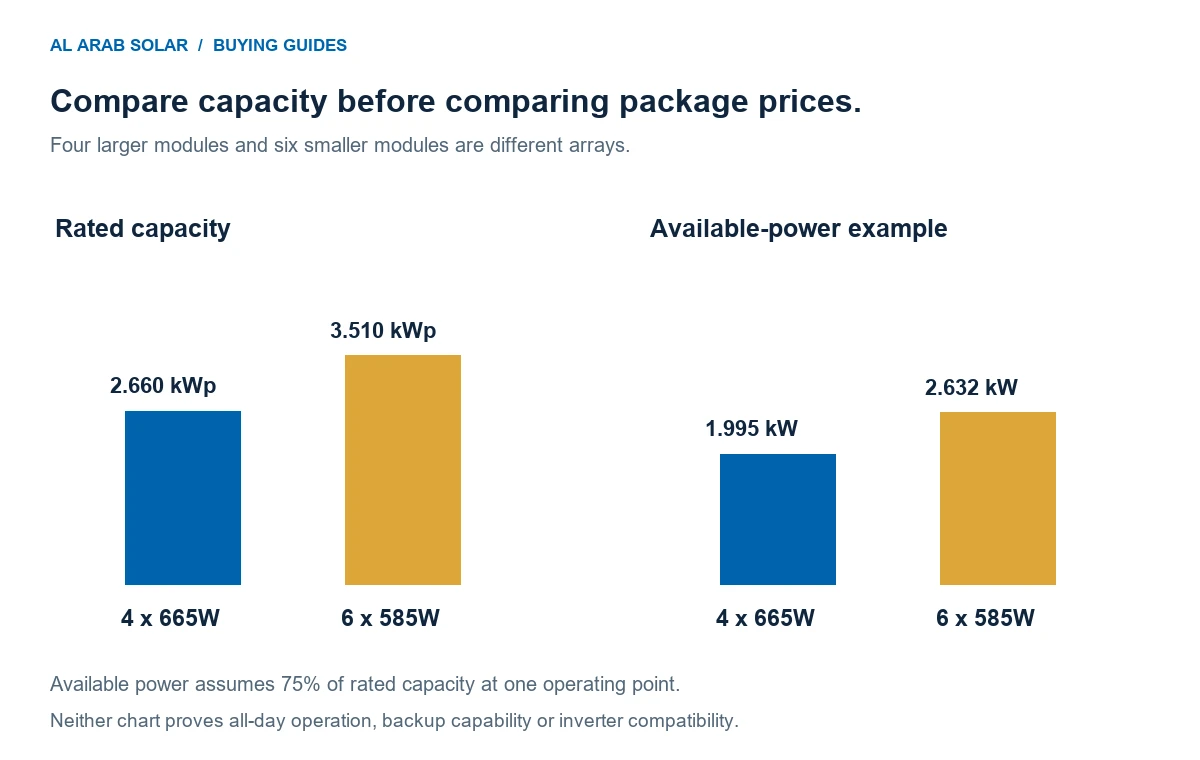
Suppose you ask two suppliers for solar panels for a 1.5-ton AC. One offers four 665W modules; another offers six 585W modules. The first array is 2.66kWp and the second is 3.51kWp. That difference tells you rated capacity. It does not establish which quotation meets your operating hours, roof layout or backup requirement.
Write the same brief on both quotations: the AC model, the documented input range, the planned daytime hours, other simultaneous appliances and whether operation during a grid outage is required. Ask each supplier to identify the solar inverter model, proposed panel arrangement and the supply that covers a shortfall. Compare those answers before comparing the total.
Use the 1,500W example as a cross-check. Under the stated 75% operating assumption, four 665W panels represent 1,995W available to the load, while six 585W panels represent 2,632.5W. Both exceed 1,500W at that assumed point. Only the second exceeds the cited 2,210W upper input at that same factor. Neither calculation demonstrates all-day operation.
Now ask about time. If the assumed average load is 1.5kW for six hours, the AC needs 9kWh. Under the separate illustrative daily assumptions, the two arrays represent roughly 8.98kWh and 11.85kWh respectively, before any loads excluded from that model. Those are conditional estimates, not measured roof production. A larger array can still be unsuitable if its string voltage, current or physical layout is wrong.
When comparing solar panels for a 1.5-ton AC, ask for the reason behind any extra modules. Is the allowance for additional household energy, battery recharge, a different operating window or a valid string arrangement? A clearly explained allowance is more useful than an unexplained “standard package.” Ask which assumptions would change the recommendation.
Finally, compare the written scope. Check whether mounting, protection, cabling, labour, transport and commissioning are included. Confirm model-specific warranty terms and the route for a claim. An equipment-only price and a complete installed quotation should not be treated as equivalent. Keep the accepted model list and exclusions with your invoice.
Questions to settle before paying for solar panels for a 1.5-ton AC
Can I select solar panels for a 1.5-ton AC from its running amps alone?
Not reliably from one displayed amperage. Ask whether the figure is a measurement, a rated value or a low-load operating point. For AC equipment, volts multiplied by amps alone is not a complete real-power calculation when power factor matters. Use manufacturer input data or a suitable real-power measurement for the load check. Keep operating hours in the separate energy calculation.
Are higher-watt solar panels for a 1.5-ton AC always a better choice?
A higher nameplate rating can reduce module count, but it does not settle roof fit, input current or string voltage. Compare total array kWp and the exact module specifications. For example, five 665W modules total 3.325kWp; six 585W modules total 3.510kWp. Fewer panels and more rated capacity are different comparisons. The layout must satisfy the chosen inverter’s documented limits.
Can I buy solar panels for a 1.5-ton AC now and add a battery later?
When buying solar panels for a 1.5-ton AC in stages, confirm the intended operating modes before ordering the solar inverter. A future battery needs a supported voltage platform, charging and discharge limits, and any required BMS communication. The panel plan must eventually cover the intended daytime load and battery recharge. Do not assume a later battery fixes an incompatible inverter or an undersized daily energy budget.
Will solar panels for a 1.5-ton AC keep it running when the grid fails?
The panels alone do not determine that. Ask whether the specified solar inverter supports the required backup or batteryless mode, how the AC circuit is supplied and what happens when generation falls. Have the installer confirm the arrangement from the exact equipment documentation. “Hybrid” on a quotation is not a complete explanation of outage behaviour.
How should I plan solar panels for a 1.5-ton AC used mainly at night?
Start with the night-time energy requirement and the available supply. If battery backup is required, size usable storage and its discharge capability first, then allow for recharge energy during the available solar window. Do not reuse a daytime-only panel count unchanged. The 7.41kWh example above is only for its stated load, duration and efficiency assumptions; it excludes other loads and inverter self-consumption.
What can Al Arab Solar confirm about solar panels for a 1.5-ton AC before I order?
Send the AC label, usage hours, other loads and existing equipment models. We can discuss the listed equipment options, current prices, availability and the details that need checking before purchase. A final site layout and electrical design still need assessment by the responsible installer. If a required specification is missing, ask for it in writing rather than accepting an assumed value.
Keep a decision record: before buying solar panels for a 1.5-ton AC, save the AC label photo, the load assumptions and the equipment quotation together. Note which hours need backup, which appliances are excluded and who will confirm the final string arrangement. If your usage changes, return to those inputs rather than copying the original count.
For example, moving two operating hours from midday to the evening can change the supply and storage requirement even if the daily running time stays identical. Adding a second AC or a battery-recharge target also changes the brief. Recheck the calculations and the proposed equipment before expanding the system; do not treat the first quotation as a universal design for later additions.
Get a useful quotation: send these six details
- A clear photo of the AC model and electrical label.
- Daily operating hours and how many fall after sunset.
- Other appliances that will run at the same time.
- Whether the goal is bill reduction, daytime use or outage backup.
- The exact existing solar inverter and battery models, if any.
- Usable roof dimensions and obvious shading.
Ask for an itemised quotation showing panel model and quantity, solar inverter, storage if needed, mounting, protection, cabling, labour and exclusions. Panel-only prices are not a complete system price.
Choosing solar panels for a 1.5-ton AC? Start with its label.
To discuss solar panels for a 1.5-ton AC with Al Arab Solar in Shah Latif Town, Karachi, share the label, operating hours and other loads. We can help narrow the equipment options and confirm current product prices and stock before you buy.
Discuss my AC solar requirement ↗Compare current solar panels · Browse solar inverters · Explore battery options
Catalogue links stay useful as models change; this guide does not freeze a product price or certify a particular bundle. Delivery is currently within Karachi; confirm charges and arrangements before ordering. Calculations are illustrative planning estimates. Source check: 24 October 2026. No claim of an on-site test or measured installation yield is made. The cover is an editorial illustration.